From its beginnings in the 17th century, The Auld Kirk has played a huge part in the history of Ayr; be it the Covenanters, Oliver Cromwell, or our national baird Robert Burns as well as honouring those who have fought in the two World Wars and other conflicts. Although The Auld Kirk is steeped in history – it is not a museum, but a living active church.
The Church Building
‘A’ Listed Building
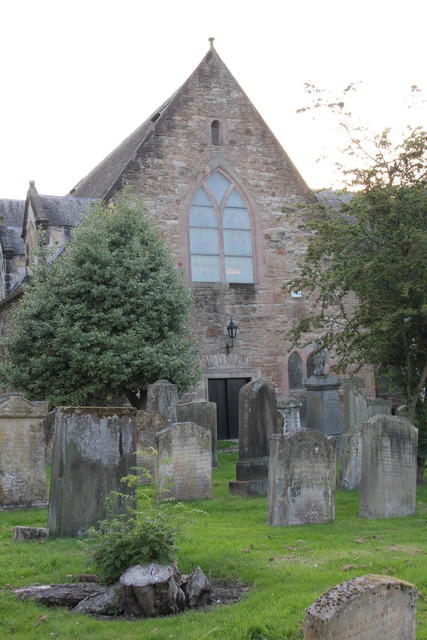
The approach to The Auld kirk is through Kirkport and the 1656 lychgate into the Kirk yard. The local commander, Colonel Alured, authorised funds to help pay for the 1654 T-plan replacement kirk after Cromwell’s troops had occupied the old Church of St John on the sands (St John’s Tower in the Citadel Place is the only remaining part). The remainder of funds were raised by local people.
The Kirk has now a cruciform shape after respectful alterations were made by David Bryce of 1836. High-quality interior with three lofts and a splendid double-decker pulpit. The Merchants’ loft (facing pulpit), the Sailors’ loft (above left) and the Trades’ loft (above right – outside entry) are all supported by Corinthian columns.
It seats around 900.
Upstairs
Sailors’ Loft
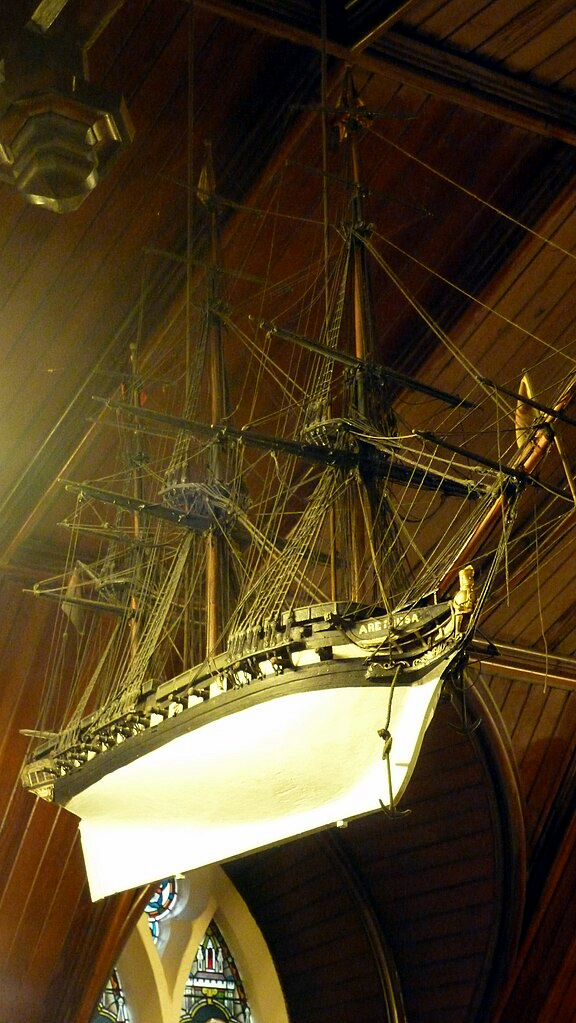
Suspended from the ceiling there is a model of a ship named Arethusa. It is a 42-gun ship with 21 ports on each side and is a successor to a model of a barque given by French sailors in 1662 to thank the folks of Ayr for the help which they gave after they were shipwrecked in Ayr Bay. Visiting sailors used to sit in this loft. The loft has two windows: one window is of modern glass showing Christ on Waves and the second one is the Garallan window of stain (not painted) glass.
Trades’ loft
This loft can only be accessed from the outside of the church. Various trades of town life sat here with the Chairman of Trades Council sitting in the centre – there was a robust rivalry for chairmanship.
There are shields at the lower edge of the loft’s front panels representing the different trades: eg fleshmen, bakers, etc.
Merchants’ loft
The clicking door half-way up stairs had a sneck – a man appointed to prevent children rattling it during services and throwing stones into the doorway. In this loft you can find the statue of John Welch (on loan) – who was Minister from 1600-02.
The present loft has been extended and the rake increased.
The Merchants would be sitting here on Sundays and met here on Mondays as Town Council. There is a long table at the back of the loft which was for tall hats to be deposited on the way to the pew. The front pew is still reserved for the Provost and Council for the annual Remembrance Day Service and for Kirkin’ of the new council.
Looking into Chancel Area
The wooden ceiling replaced the hessian ceiling after the church was built. The roof space above, with huge beams, was shaped without modern tools but using adze, oak nails, and slates secured by wooden pegs. This area is accessible from the Merchants’ loft.
The organ loft was originally behind the pulpit. The current full pipe organ is not electronic, though controlled electrically.
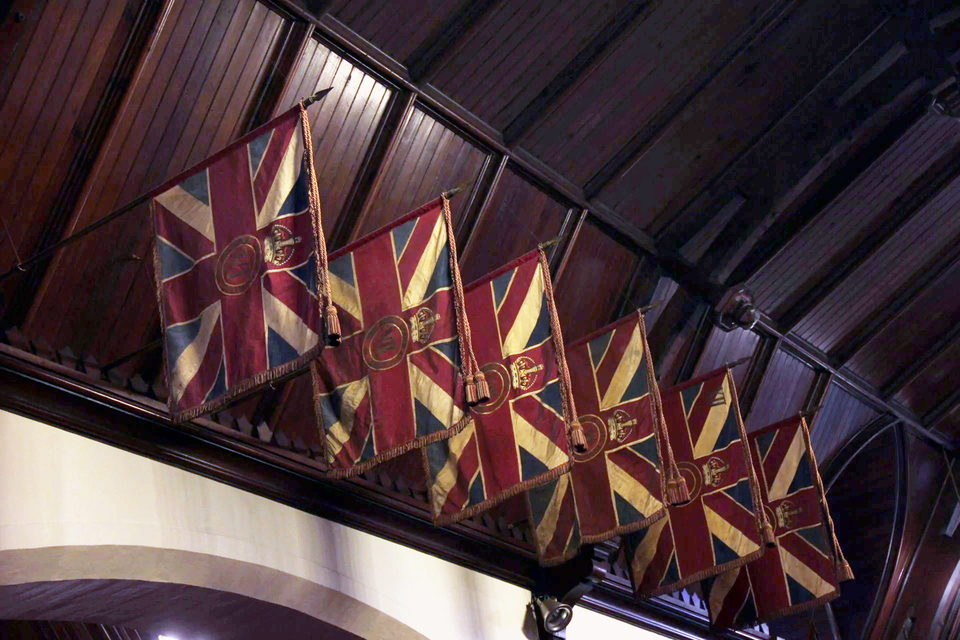
There are militia colours (flags) of local regiments; Ayrshire Yeomanry, and Royal Scots Fusiliers. There are brass plates in the church with their descriptions. There is also a large cross with circle, from France, on the right facing the Trades’ loft.
Downstairs
Pulpit
The pulpit has a canopy which acts as a sounding-board (necessary before microphones), and a lower pulpit for the Reader. This later one was rescued from the contractor’s yard. The pulpit was restored in 1952 and also became the church’s Second World War Memorial.
Attached to the pulpit is a wrought iron frame which holds the silver font when there is a baptism.

Pulpit wall
One of the few remaining ‘Obit’ boards records money donated to the poor in the town.
The “Amamanite” memorial depicting a woman weeping over the lost ashes of husband.

The cross above pulpit was donated by the Women’s Guild.
Communion Table
The Communion Table is dedicated at the Tercentenary in 1954 and contains panels from the old Church of St John, there is a brass plaque on the table with more information.

Front of Sailors’ loft
A Master Craftsman and his Apprentice did the carving on the lofts. On the front of the Sailor’s Loft can be seen where the two joined up as there is a small difference in the size of the carvings.
John Welch window to east of pulpit
John Welch, the son-in-law of John Knox, was the Minister from 1599-1604. When he arrived, he succeeded in quelling feuds and riots, and effected the reformation in public manners.
Under Trades’ loft
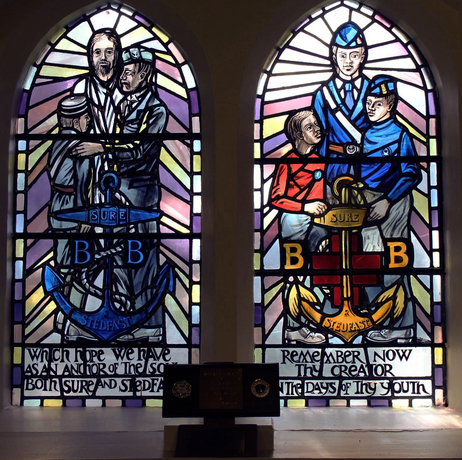
The Boys Brigade window (2nd Ayr Company) was given to the Auld Kirk at its centenary. The Memorial tablet is dedicated to Eric D Gairdner, a military surgeon and a perfect gentleman, holder of the Croix de Guerre and Distinguished Service Order (DSO).
The Modern Flaming Window (Burning Bush is a symbol of the Church of Scotland) – Dittany plant (see Exodus 3 v3) – note also motto (Latin) ‘nec tamen consumebatur’ : ‘burning but not consumed’ – The cross incorporates pillar of window.
In end wall, the Cairns Duncan window, a memorial to a previous minister (1886-1926) who set up Clog fund and went round pubs collecting money to buy clogs for barefoot children. Note the inclusion of The Auld Kirk at the bottom left. It also depicts Christ as child, St Cecilia, the hills of Arran, New Jerusalem and the Burning Bush.
There is also a memorial to Lt Col William Smith and others.
On this side there are Box pews.
There is a bronze statue of Robert Burns which is a replica of the statue in Burns Statue Square.
In front of pulpit and facing the doorway
On the immediate left, you will find the tablet for the 7th centenary of Ayr Academy in 1933. The Ayr Academy has close links with The Auld Kirk where the minister is Chaplain.
There is a glass case containing the Deed of Gift letter from Colonel Alured.
A Fastl plaque which is a memorial to Rev Gillieson, lists all ministers of Auld Kirk (Second Charge and First) is also displayed here.
Stained Glass Windows
Auld Kirk History Video
Historical Connections
Oliver Cromwell
The Auld Kirk of Ayr has a lot to thank Oliver Cromwell for. If it had not been for Ayr’s value as a strategic point in Cromwell’s subjugation of the Scots during the time of the Civil War, The Auld Kirk would not have existed in the form as we know it today. Cromwell’s army came to Ayr to requisition the parish church of St. John the Baptist in the area we now know as the Fort. Taking in the church, graveyard and surrounding land of approximately 11 acres, it was taken possession of by the military authorities in 1652. Part of the Citadel wall and walk around the area can still be seen today. It is interesting to note that some of Cromwell’s soldiers decided to stay and marry into local families.
That same year the Town Council agreed to accept 1000 merks to help towards the cost of erection of a new church. It was agreed that the site of the old Grey Friars “be bocht, and that toun be stented for als muche as to outred the samyn what is deficient of the money to be had from the English”. (“BE BOUGHT AND THAT THE TOWN VALUE AND TAX ALL TOGETHER THE LANDS AND PAY WHAT WAS DEFICIENT AFTER WHAT THE ENGLISH WERE HANDING OVER”). Four years later, the churchyard was leveled, and the “saittis and pewis” were distributed in the building since known as the Old Parish Church of Ayr – later the AULD KIRK OF AYR (ST. JOHN THE BAPTIST).
In the church is the letter that Colonel Alured, Commanding Officer of the Garrison of Ayr, wrote announcing that the 1000 merks be given to the town for the building of a new church.
THE DEED OF GIFT
“I do hereby testify that Major General Deane did promise unto ye Burrough of Ayre the soume of one thousand markes sterlinge money towards ye buildinge of a church in that Towne, by reason that theire former church was employed for ye publique, and did give me order to pay 200 lib upon laying the foundacon one foote above ground, and 200 lib when it was halfe built, and the remaynder when it was finished. In testimony whereof I have here unto sett my hand this first day of August 1654.”
MATT ALURED
I have perused the promise and doe know and agrea to accept of ye same to be true.
RT. OVERTON
A little snippet about Cromwell himself. He was born at Huntingdon on 25th April 1599 and baptised four days later in the local church called St. John the Baptist.
quia dolor sit amet consectetur adipisci velit sed quia non numquam eius modi tempora incidunt ut labore et dolore magnam aliquam quaerat voluptatem ut enim.
The Covenanters
The Auld Kirk has many links with the timelines of British history and one of these links is with the Covenanters and the “Killing Times”.
Two main turning points in Scottish history were the Reformation of 1560, and the Union of the Crowns of Scotland and England in 1603 through James VI of Scotland. The first gave Scotland a protestant church, the second saw a Scottish monarch inherit the English throne, and although both countries were protestant, the major difference in their protestant face was that in England the church recognised the monarch as its supreme head on earth with royal power being controlled through powerful bishops acting as the crown’s agents. Meanwhile in Scotland, with the recent problems of Mary, Queen of Scots being a catholic and a protestant regency for James VI, the church was able to evolve free from state control, but the state did feel that it needed to restore its authority and that’s when all the trouble began.
Today His Majesty the King is still the head of the Church of England but is only a member of the Church of Scotland and as such has no control over the Church of Scotland Assembly. James VI did not try to disguise the reforming of Scotland’s church into an anglicised way. He was an absentee monarch to Scotland and only visited Scotland once between 1603 and 1625. It was not until Charles I came to the throne that he was more determined than his father and expected absolute power from all nobles and landowners in Scotland. Charles thought the Scots an unmannerly lot and saw himself as a semi divine figure and this the Scots could not accept. He tried to push the book of Canons on to the Church of Scotland by using his royal prerogative and slowly he was trying to diminish the Church of Scotland by interfering with worship and theologian beliefs. The next step was the new book of prayer. This was introduced on Sunday 23rd July 1637 to Edinburgh and in simple terms it caused a riot. The famous tale of Jenny Geddes throwing her stool in St. Giles Cathedral comes from this era. It is a very interesting fact that when the National Covenant was travelling around the country to be signed, some women managed to sign the document but generally speaking women were not encouraged to put their name to it. The Covenant was put on public display in Greyfriars Church and over 60,000 people signed supporting Presbyterian ideas but also swearing allegiance to the crown. Effectively putting your name to this Covenant was like signing your own death sentence. The “killing times” had started. The whole country was now up in arms and it would seem like that for the next 50 years until the Glorious Revolution when William and Mary came to the throne. As people now gathered together for prayer meetings or conventicles as they were called, throughout the countryside soldiers were sent out to find them in order that they attend the King’s churches. These soldiers were garrisoned in the towns and castles. Many a person was hunted down, their fields and homes burned and their belongings thrown out and disposed of. Many a husband was killed in front of his family. Fines were imposed, some imprisoned and others banished from their homeland and sent to America. Many of the covenanters grouped together and marched to Edinburgh only to be defeated but in other instances were victorious especially at Drumclog in Lanarkshire. No one seemed to be safe.
There is a gravestone where 7 martyrs are buried in The Auld Kirk with the following description:
Here lie seven Martyrs for our Covenants,
A sacred number of triumphant Saints,
Pontius McAdam the unjust Sentence past,
What is his own the world will know at last,
And Herod Drummond caus’d their Heads affix,
Heav’n keeps a record of the sixty-six.
Boots, thumbkins, gibbets were in fashion then,
LORD, let us never see such Days again.
The men who died were: James Smith, Alexander MacMillan, James Mcmillan, John Short, George MacCartney, John Graham and John Muirhead who all belonged to the south west of Scotland.
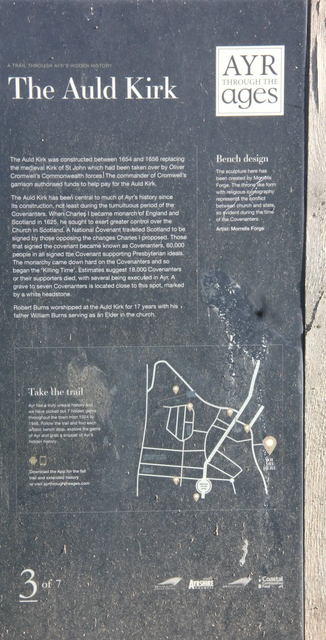
Ayr continued to be involved in the Covenanting times with many groups of soldiers being billeted in the town and helping themselves to whatever they could steal. There were other hangings and in 1684 the heritors of the county were summoned to Ayr to appear before a court in The Auld Kirk to await their destiny for their involvement in the covenanting. Some were fined and others freed. One name notoriously linked with the killing times was John Graham of Claverhouse, who was given the Freedom of the Burgh of Ayr. There are many places in Ayrshire that have Covenanting links, too many to list here. One other church to visit is Fenwick, which has a Covenanting flag and where some covenanters found their final resting place in the churchyard. Not far from Fenwick is Lochgoin hosting a farmhouse which has a great collection of Covenanting artefacts. In the National Museum of Scotland there is the Rev. Alexander Peden’s mask and many books can be found on the subject. The Scottish Covenanter Memorials Association looks after all the memorials – memorials to these who died for the freedom of their faith.
Robert Burns
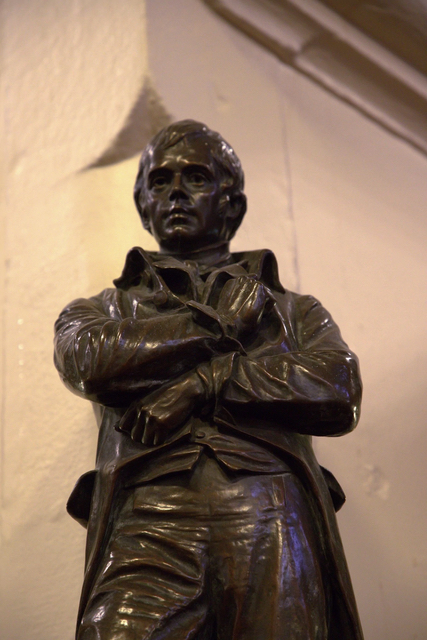
At the time of Robert Burns the parish of Alloway had been annexed to that of Ayr, so the people of Alloway and district worshipped in the parish church in Ayr, now known as ‘The Auld Kirk of Ayr’. William Burnes (the poet’s father) served as an Elder and also held the post of Presbytery Elder. Robert Burns worshipped here for 17 years. Naturally we would like to know where the Burns family sat in Church. We learn that in 1698 ‘furms are to be permitted to be set in the body of the kirk for the Alloway and Burrowfield folk’. Assuming that ‘the body of the kirk’ meant the area facing the pulpit, we place the Burns family very near to where the bronze statuette of the poet now stands. It was in The Auld Kirk as a child that Robert Burns learned to worship God, reinforcing his father’s teaching at home.
 The Auld Kirk of Ayr